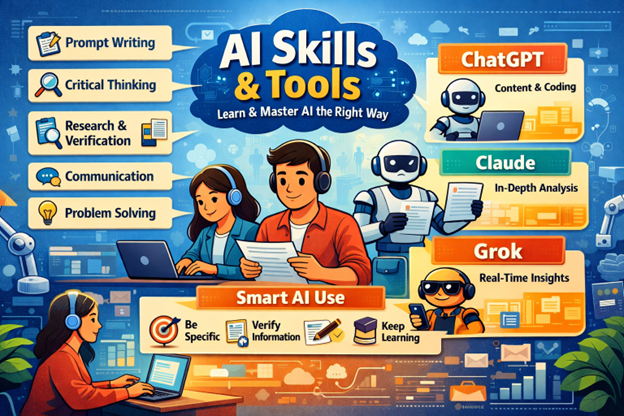

Artificial Intelligence (AI) is no longer a technology of the future—it is part of our daily lives. From students using AI for research to businesses automating customer service, AI tools are transforming how we work, learn, and solve problems. However, simply using AI is not enough. To truly benefit from AI, people must develop the right skills and understand how to use these tools effectively.
Essential AI Skills Everyone Should Learn
1. Prompt Writing Skills
One of the most important AI skills today is learning how to write clear and effective prompts. AI tools like OpenAI ChatGPT, Anthropic Claude, and xAI Grok work best when users provide specific instructions.
Instead of asking:
"Tell me about business"
A better prompt would be:
"Explain five ways small businesses can use AI to improve customer service in simple terms for a startup founder."
The better the prompt, the better the result.
2. Critical Thinking
AI is powerful, but it is not always correct. People must learn to question, verify, and analyze AI-generated responses instead of accepting everything as a fact.
Critical thinking helps users:
· Identify wrong information
· Detect bias
· Make better decisions
· Improve AI-generated content
AI should support human thinking, not replace it.
3. Research and Verification
Factchecking is an essential skill when using AI. Users should confirm information from trusted sources, especially academic, business, legal, or health-related content.
AI saves time, but verification ensures accuracy.
4. Digital Communication Skills
AI tools are often used for writing emails, reports, proposals, and content creation. Strong communication skills help users guide AI properly and refine outputs to match their goals.
Knowing how to explain your needs clearly improves AI performance significantly.
5. Problem-Solving Skills
AI works best when users understand the real problem they want to solve. Whether it is improving productivity, automating tasks, or generating ideas, strong problem-solving skills help users ask smarter questions and get better results.
Practical Example: Using AI, the Right Way
Imagine a university student preparing for an internship interview.
Poor Use of AI:
The student asks:
"Help me with interview questions."
This is too broad, so the answer may be generic and not very useful.
Smart Use of AI:
The student asks:
"I am applying for an engineering internship at GHACEM. Generate 10 likely interview questions for a materials engineering graduate and provide strong sample answers."
This prompt is specific, targeted, and gives much better results.
Even Better Use:
After receiving the answers, the student should:
· Review and personalize the responses
· Verify technical information
· Practice speaking naturally instead of memorizing word for word
This is how AI becomes a powerful assistant instead of just a shortcut.
Popular AI Tools and What Each Is Best For
1. OpenAI ChatGPT
Best For:
· Content writing
· Blog posts
· Emails
· Coding help
· Business ideas
· Learning new concepts
· General productivity
Why It Stands Out:
ChatGPT is excellent for structured writing, brainstorming, explanations, and professional communication. It is highly flexible and works well for students, developers, entrepreneurs, and professionals.
2. Anthropic Claude
Best For:
· Long document analysis
· Research summaries
· Professional writing
· Reports
· Detailed reasoning
· Academic support
Why It Stands Out:
Claude performs very well when handling long texts and deep analysis. It is often preferred for reviewing documents, reports, and thoughtful writing tasks.
3. xAI Grok
Best For:
· Real-time discussions
· Social media trends
· Quick opinions
· Casual idea generation
· Fast conversational responses
Why It Stands Out:
Grok is useful for fast-moving topics and internet conversations, especially when users want fresh discussions and trend-based insights.
The Right Way to Get the Best Out of AI Tools
1. Use AI as an Assistant, Not a Replacement
AI should help you work faster and smarter, but your personal judgment remains important. Use AI for support, brainstorming, drafting, and learning—not blind decision-making.
Human creativity and wisdom still matter most.
2. Be Specific With Instructions
Vague prompts produce vague answers. Always include:
· Context
· Goal
· Audience
· Format
· Tone
For example:
"Write a professional email to a client requesting a project deadline extension."
This gives much better results than simply saying:
"Write an email."
3. Edit and Improve AI Output
Never copy and paste AI responses without reviewing them. Edit for:
· Accuracy
· Personal voice
· Relevance
· Professionalism
The best results come from collaboration between human intelligence and artificial intelligence.
4. Keep Learning
AI tools evolve quickly. Staying updated with new features, tools, and best practices helps users remain competitive in school, business, and career growth.
Continuous learning is the real advantage.
5. Use AI Ethically
Responsible AI use matters. Avoid plagiarism, misinformation, and misuse of AI-generated content. Ethical use builds trust and protects credibility.
AI should be used to create value, not shortcuts without responsibility.
Final Thoughts
AI is becoming one of the most valuable tools of our generation, but success with AI depends on the skills behind its use. Learning prompt writing, critical thinking, research, communication, and problem-solving will help people unlock the full power of AI.
The future does not belong to people who simply use AI—it belongs to those who know how to use it wisely.
Master the skill, and AI becomes your greatest productivity partner.






Leave A Comment
You must be logged in to leave a comment.