
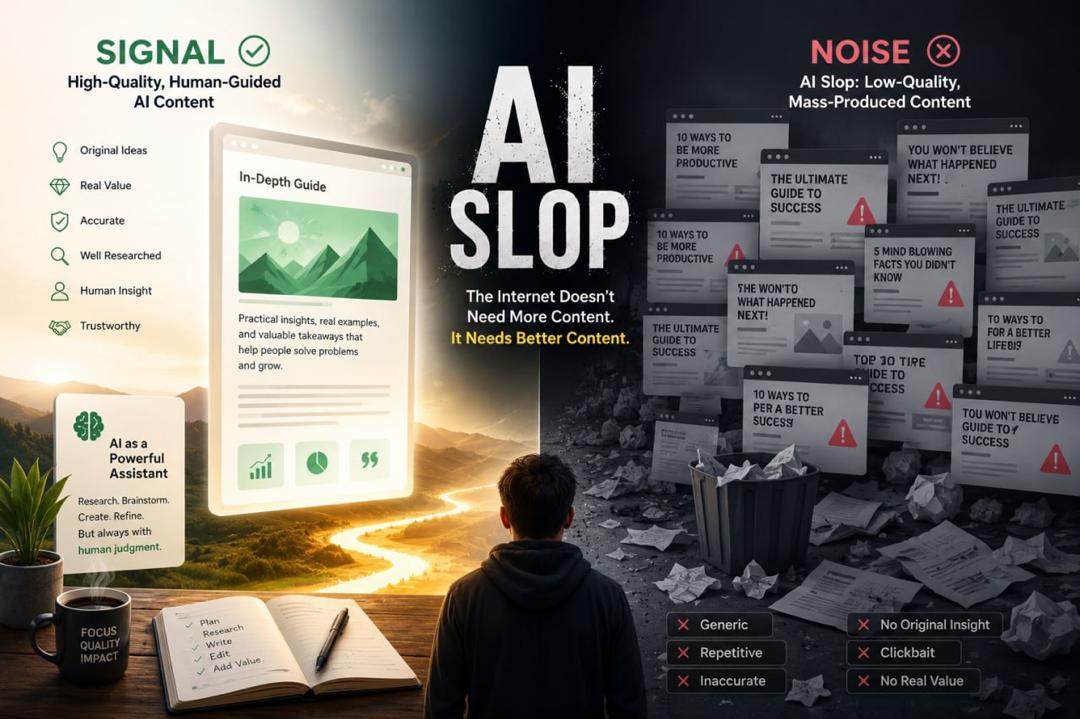
Artificial Intelligence has made it easier than ever to create content. In just a few seconds, AI can generate articles, social media posts, images, videos, presentations, and even code.
While this has unlocked incredible opportunities, it has also created a growing problem known as AI Slop.
From low-quality blog posts and repetitive social media content to fake images and misleading videos, AI slop is becoming increasingly common across the internet.
So what exactly is AI slop, and why should creators, businesses, and readers care?
Let's explore.
What Is AI Slop?
AI slop refers to low-quality, mass-produced AI-generated content that offers little or no real value.
It's content created quickly with minimal human review, editing, or expertise.
Instead of informing, educating, or entertaining people, AI slop often exists simply to generate clicks, views, search traffic, or advertising revenue.
Examples include:
● Articles repeating the same information
● Blog posts with no original insights
● AI-generated images with obvious errors
● Fake news created using AI
● Videos made from copied scripts and robotic voices
● Spam social media posts
● Websites filled entirely with AI-written content
The problem isn't AI itself—it's the careless use of AI.
Why Is AI Slop Becoming So Common?
There are several reasons.
1. AI Makes Content Creation Extremely Fast
Tasks that once took hours can now be completed in minutes.
Some creators prioritize quantity over quality.
2. Search Engine Traffic
Many websites produce hundreds or thousands of AI-written articles hoping to rank on search engines.
Unfortunately, many of these articles provide little real value.
3. Low Production Costs
Creating content with AI is significantly cheaper than hiring writers, designers, editors, or researchers.
Without proper oversight, this often leads to lower-quality content.
AI tools can generate endless quotes, motivational posts, videos, memes, and images.
When speed becomes the priority, originality often suffers.
Here are common warning signs.
● Generic headlines
● Repetitive wording
● Little or no real expertise
● No original research
● No personal experience
● Factually incorrect information
● Clickbait titles
● Generic stock-style AI images
● No credible sources
● Excessive keyword repetition
If every article feels exactly the same, you're probably reading AI slop.
It Reduces Trust
When readers repeatedly encounter inaccurate or low-value content, they become less likely to trust what they find online.
It Spreads Misinformation
AI sometimes produces incorrect or fabricated information.
Without human review, these mistakes can spread rapidly.
If everyone publishes nearly identical AI-generated content, originality becomes harder to find.
Unique voices get buried under a flood of generic material.
Nobody enjoys reading 2,000 words that could have been explained clearly in 500.
High-quality content respects the reader's time.
It's important to make one thing clear:
AI itself is not AI slop.
AI is simply a tool.
Just as a camera can produce both award-winning photography and blurry snapshots, AI can produce both excellent and poor content.
The difference is the human behind it.
Great creators use AI to:
● Brainstorm ideas
● Improve writing
● Speed up research
● Edit drafts
● Generate code
● Organize information
● Improve productivity
Poor creators simply copy and publish whatever AI generates.
Add Your Own Expertise
Share real experiences.
Include lessons you've learned.
Offer insights AI cannot invent.
Never publish AI-generated content without reviewing it.
Verify statistics, names, quotations, and technical information.
Rewrite sections.
Improve the flow.
Remove repetition.
Add examples.
Make the content sound human.
Use:
● interviews
● case studies
● screenshots
● charts
● personal experiments
● customer stories
Original information immediately makes your content more valuable.
Ask yourself one question before publishing:
Will someone genuinely benefit from reading this?
If the answer is yes, you're already ahead of most AI-generated content online.
As AI tools become more powerful, simply generating content will no longer be enough.
Search engines and readers are increasingly rewarding content that demonstrates:
● Experience
● Expertise
● Original thinking
● Accuracy
● Credibility
● Human perspective
The creators who combine AI with genuine knowledge will stand out.
Those who rely on mass-produced AI content alone will struggle to earn trust.
AI is one of the most powerful technologies of our time, but with great power comes responsibility.
The goal shouldn't be to publish more content—it should be to publish better content.
Use AI to think faster, research deeper, and work more efficiently—but let your knowledge, creativity, and judgment shape the final result.
In the end, people don't remember who generated the content.
They remember who helped them solve a problem.






Comments