
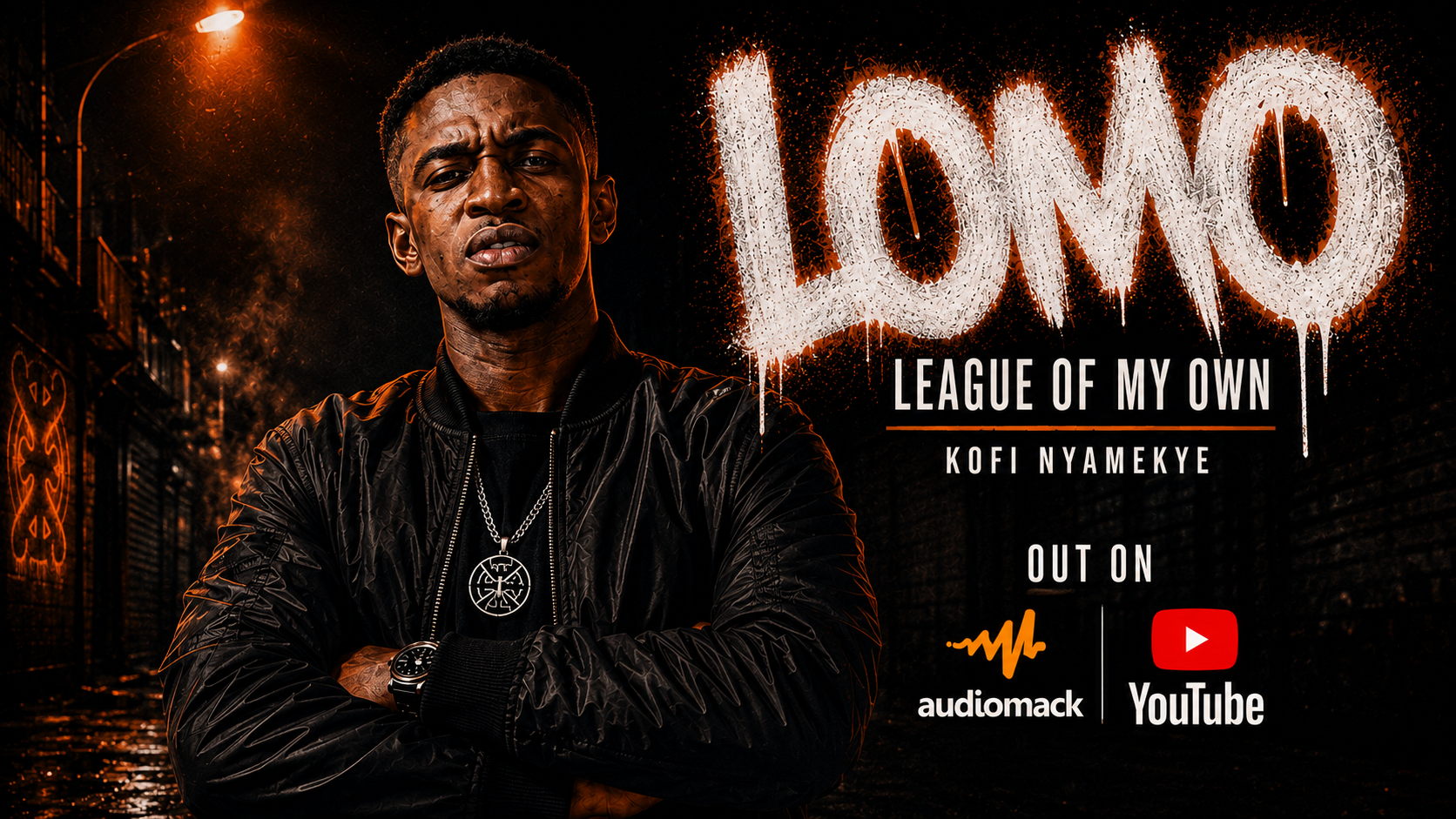
League of My Own, or LOMO, is a Twi and English rap single I built from start to finish with AI tools. The goal was simple: show that an AI-made song can be released, marketed and heard like any other record. The honest story is that nothing worked on the first try. Every stage came down to iteration, so here is the process, the tools and the rounds it took.
I wanted a bar-heavy, hardcore track in the lane of Strongman's "LOMO (League of My Own)" featuring Sarkodie, with a hook people could repeat. Same energy, original song, original voice.
The toolkit
- Claude: lyrics and every prompt, from the music style to the image and video briefs
- Suno: the track itself
- ChatGPT: cover art and other image generation
- WAN on Higgsfield: the whole video
- Clipchamp: final assembly
The sound: three passes in Suno
Each pass changed one thing on purpose.
- Pass one: drill-trap lean, sliding 808s, talking drum and dark piano at 140 BPM. Great atmosphere, but too melodic for a rap record.
- Pass two: hardcore hip-hop with cinematic strings and punchy trap drums at 138 BPM, for the weight of the reference.
- Pass three: the rap still felt slow, so I pushed to 145 BPM, dropped the strings and added rapid hi-hats. Hi-hat speed changes how fast a beat feels more than the BPM number does.
Two rules held throughout: no artist names in the prompt, and the talking drum stays as the signature sound.
The lyrics: rewritten to fit the beat
The song moves between Twi, English and Ghana Pidgin, so spelling had to be exact, down to details like "Nkwaseasɛm dodoɔ". A fast, confessional voice carries the verses, and a slower, elder-authority voice carries the hook, which is what makes it feel like a chant.
When the tempo went up, the verses went through another round with denser syllables and tighter internal rhymes. A faster beat with the same slow flow still sounds sluggish, so the lyrics had to change, not just the BPM. The line people remember is the hook: "No be crowd matter, na me be original."
The cover art: four rounds
The biggest lesson was to fix the look before the first render: jet black, steel grey, one burnt-orange streetlight and a glowing Adinkra symbol as a recurring anchor, with a graffiti "LOMO" title.
- Format: the first render came out portrait. Streaming covers are square, so the brief switched to 1x1.
- The talking drum: it first hung off the shoulder like a bag, then vanished, then came back oversized and floating. The fix was describing the real shape (hourglass body, two heads, crisscross cords), setting a small scale and tucking it under the arm.
- Final polish: a tighter pose and harder grain made it read as hip-hop instead of a portrait.
The video: storyboard first, then short blocks
The video was a chain of 10 to 15 second blocks. Each was planned as a three-panel storyboard before I spent any generation credits, then generated in WAN with one action, one light and one camera move per shot. Clips were cut together in Clipchamp against the track.
For variety, it opens in a dark alley with a talking-drum solo, moves to a rooftop crowd for the chorus and ends on a daytime basketball court for the second verse. Wardrobe changes give it the rhythm of a real music video.
What broke, and the fix:
- Storyboard order drifted. The rapper's face landed in the last panel instead of the first. Naming each shot's position (first, middle, last) fixed it.
- Crowd scenes. Multi-face shots are a known weak spot, so crowds stayed silhouetted or blurred, with a rapper-only fallback ready.
How iteration got the result
Looking back, no single prompt produced LOMO. Each stage improved because I treated every failed output as information.
- One change per round. Tempo, hi-hat speed, image format, shot order: changing one variable at a time showed exactly what worked.
- Feedback loops between tools. When the beat got faster, the lyrics were rewritten. When the cover was locked, it became the reference for the storyboard and video.
- Specific fixes beat bigger prompts. The drum went from a floating prop to a believable detail only after I described its real shape and scale.
- Cheap rounds first. A storyboard check costs nothing, while a failed video generation costs credits.
- Fallbacks for weak spots. Knowing crowds were risky meant a backup was ready before I needed it.
The rollout: video first, audio the next morning
The release ran as a drip across every platform, with captions for TikTok, Instagram, Facebook and X.
YouTube also got its own 16:9 thumbnail, cropped tighter than the square cover so the graffiti mark stays readable at small sizes, plus tags mixing branded terms with Ghana rap and Asakaa discovery terms.
You can hear LOMO on Audiomack and watch the video on YouTube.



Comments