
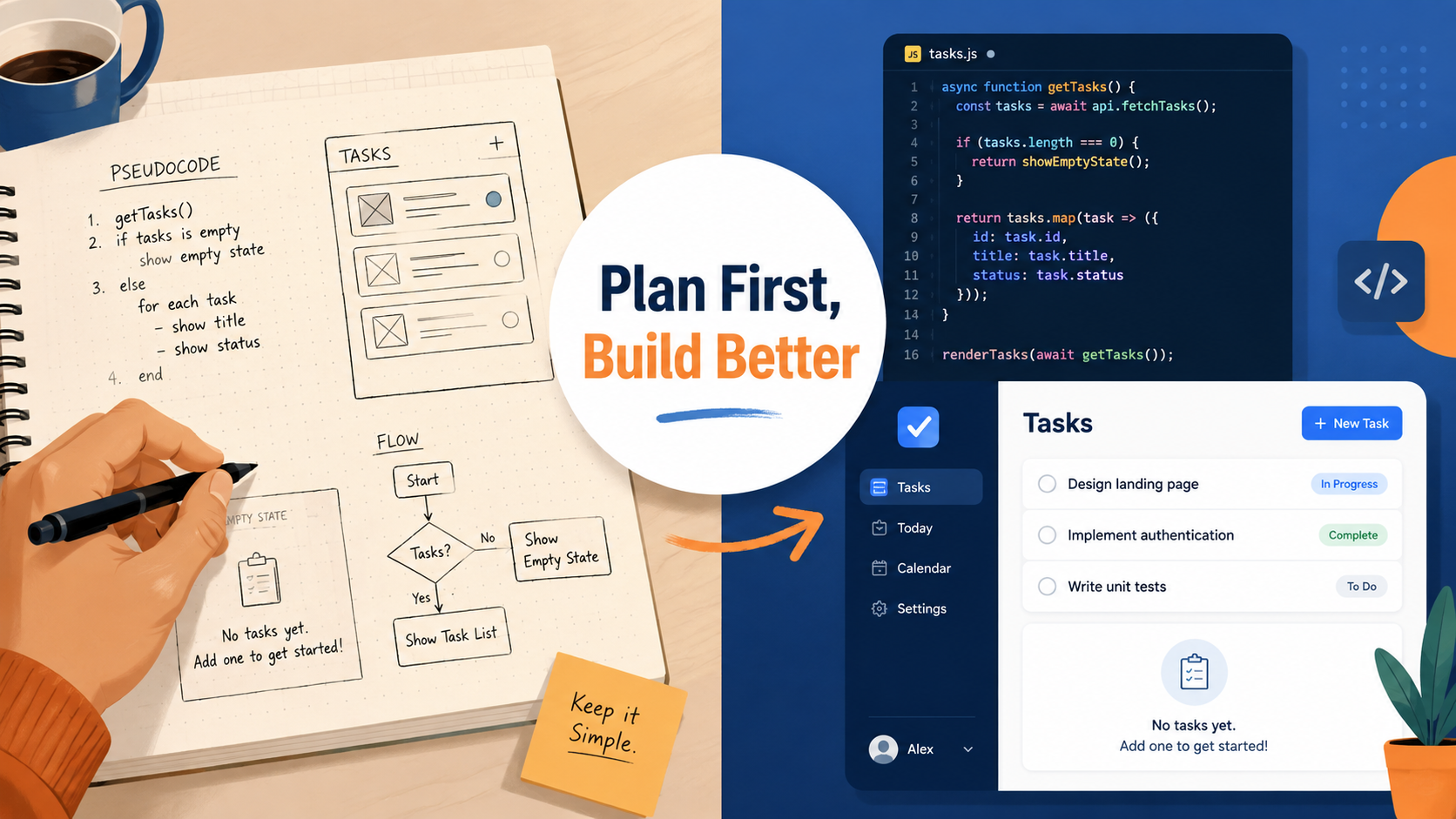
Ask a senior developer, a UX designer, and a structural engineer what separates good work from rushed work, and you'll hear a surprisingly similar answer: none of them start with the finished product. They start with a rough version of the idea, pseudocode, a wireframe, a sketch — and only then move to the real thing.
This "get it down first" habit isn't a formality. It's one of the most reliable ways to catch mistakes while they're still cheap to fix. And it shows up in almost every tech discipline, even ones that don't look alike on the surface.
Pseudocode: Thinking Before Typing
Pseudocode is plain-language logic written before actual code. It has no syntax to get wrong, so you can focus entirely on whether your solution makes sense.
Writing pseudocode first tends to:
- Surface logic errors early, before they're buried in brackets and semicolons
- Make debugging faster, since you're fixing an idea instead of untangling code
- Help teams collaborate, because non-coders can follow plain language even if they can't read a function
- Double as early documentation, since many developers keep it as comments or docstrings
As one breakdown of the practice puts it, pseudocode lets you catch design flaws in the "thinking" stage rather than the "building" stage, which is far cheaper to correct (Built In). The relationship between pseudocode and code mirrors the relationship between a plan and its execution, one is strategy, the other is the work itself (Facing the Facts).
Wireframes: Designing Without the Distraction of Polish
For UX and product designers, the equivalent step is the wireframe, a bare-bones layout with no color, no branding, no final copy. Just structure.
Skipping this step is expensive. Multiple design analyses point to Nielsen Norman Group research showing that low-fidelity wireframing can cut overall design time by up to 50%, because teams resolve layout and usability problems before a single pixel is styled (SolveIt; UITOP). Other analyses of the same research put the return even higher, estimating that every dollar spent catching a usability issue at the wireframing stage saves $10–$100 in rework once the product is built or shipped (Wireframing Tools).
The logic is simple: a wireframe can be redrawn in minutes. A finished interface takes hours or days to redo. The earlier a bad decision is caught, the less it costs.
Sketches and Diagrams: The Engineer's First Draft
Long before software existed, engineers were doing the same thing with pencil and paper. A structural sketch, a circuit diagram, or a materials layout lets an engineer test an idea's feasibility without committing time, money, or physical material to it. It's the same principle as pseudocode and wireframing, just older, andthis arguably is where the habit started.
Why This Habit Cuts Across Every Tech Career
Whether the output is a paragraph of pseudocode, a gray-box wireframe, or a hand-drawn diagram, the underlying job is identical: separate the thinking from the building, so mistakes get caught while they're still just lines on a page.
This matters for anyone building a tech career, not only developers or designers:
- Data analysts sketch out a query's logic or a dashboard's layout before writing a single line of SQL
- Product managers draft a rough spec or user flow before it becomes a ticket
- Cloud and DevOps engineers diagram infrastructure before provisioning a single resource
- AI and machine learning practitioners outline a pipeline's steps before touching a notebook
In every case, the "draft" step is what turns a vague idea into something buildable, and this is usually the difference between a smooth project and one full of expensive rework.
Making It a Habit, Not an Afterthought
If you're early in a tech career, this is one of the simplest habits to adopt immediately, and it costs nothing:
- Before writing code, write three to five lines describing what each part should do
- Before designing a screen, sketch the layout on paper or in a basic wireframing tool
- Before building anything with multiple moving parts, diagram how those parts connect
None of this needs to be polished. Its entire value comes from being quick, rough, and easy to throw away, because throwing away a bad sketch costs nothing, while throwing away finished work costs real time.
The tools change by discipline. The instinct doesn't. Get the idea down first, then build.
Learn practical, job-ready tech skills — from coding to data to design — for free at CodeDevPay Academy.






Comments